Showing posts with label software development. Show all posts

Wednesday, 27 December 2023

Top Machine Learning Libraries In Java


Java is the only general purpose programming language which finds wide use by developers for building secure enterprise grade applications, desktop applications, web applications, and mobile apps. Java 9 further helps developers to build applications for both large and small devices by providing a number of new features – a new module system, a new command line tool, and several updated APIs. At the same time, Java is currently one of the most popular programming languages for machine learning.

Machine Learning Libraries In Java

A large percentage of data scientists and machine learning developers prefer Java to other programming languages while improving network security, protect cyber attacks, and detect frauds. The language features available in Java makes it easier for programmers to write machine learning algorithms. The developers can accelerate custom machine learning application development by taking advantage of the Machine Learning libraries In Java.

Brief Overview of 10 Robust Machine Learning Libraries In Java

1) Java Machine Learning Library (Java-ML)

Java-ML is designed as a collection of machine learning algorithms. It even provides interface for various types of machine learning algorithms. By design, the library is a clear interface instead of graphical user interface. Hence, only skilled Java programmers and developers are able to use it . They have option to learn Java-ML by referring to its well-documented source code as well as tutorials and code samples.

2) Java Statistical Analysis Tool (JSAT)

The Java library for machine learning was developed by Edward Raff for self-education. JSAT still provides implementation of standard machine learning algorithms in pure Java. The developers can even use JSAT as a lightweight Java library without external dependencies. But they cannot use the library to solve complex machine learning project. JSAT still helps machine learning developers to sole small to medium size problems quickly.

3) Waikato Environment for Knowledge Analysis (Weka)

The machine learning algorithms provided by Weka helps developers to simplify a variety of data mining tasks. Weka even provides a number of tools for data pre-processing, classification, clustering, regression, and visualization. The developers even have option to use the machine learning algorithms provided by Weka to a dataset directly or call the algorithms from Java code. At the same time, the developers can also use Weka to create new machine learning schemas without putting extra time and effort.

4)  Konstanz Information Miner (KNIME)

KNIME was originally an analytics and reporting library. But KNIME is currently one of the most popular build software for advanced data science. The tools provided by KNIME help users to discover new potential hidden in data, mine data for fresh insights, and predict new future. The data scientists can use KNIME to integrate different types of data collected from various sources to widely used tools. At the same time, the software developers can use KNIME to connect applications to data sources by creating custom connectors, implement new algorithms, and create new data visualization.

5) Environment for DeveLoping KDD-Applications Supported by Index-Structures (ELKI)

The open source data mining software is written in Java programming language. But it is compiled with Python and Maven. Despite being designed as research software, ELKI is designed based on extensions. It allows developers to use algorithms, indexes, visualization, data types, and distance functions as extensions. However, ELKI allows developers to keep the data management tasks and data mining algorithms separated. The separation further makes it easier for programmers to evaluate data mining algorithms and data management tasks independently.

6) RapidMiner

The commercial data science platform is currently being used by large enterprises like Samsung, GE, SalesForce, Cisco, Hitachi and Siemens. RapidMiner comes with a set of features and tools to simplify various tasks performed by data scientists. It even uses automated machine learning to speed up and simplify various data science projects. The data scientists can use RapidMiner Studio to create visual workflow, RapidMiner Server to simplify model deployment and management, and RapidMiner Radoop to implement code free data science.

7) Massive Online Analysis (MOA)

The widely used data stream mining framework comes with a number of machine learning algorithms and tools to evaluate the algorithms. While using MOA, developers can avail a variety of machine learning algorithms – classification, clustering, regression, concept drift detection, outlier detection, and recommender system. The developers can use MOA to perform real-time big data streaming and large scale machine learning. They even have option to extend and scale the Java-based framework to meet complex project needs.

8) Eclipse Deeplearning4j

Deeplearning4j is a Java based platform. The distributed deep learning library is compatible with a number of JVM-based programming languages – Kotlin, Scala and Clojure. Also, Deeplearning4j finds extensive use as a scalable and open source distribution library in varied business environments on distributed CPUs and GPUs. It even features micro-service architecture and takes advantage of a robust distributed computing framework like Hadoop. The developers can even avail the tools provided by Deeplearning4j to perform machine learning ETL operations, evaluate machine learning algorithms, and integrate Java and native C++.

9) Mallet

Mallet is designed as a Java-based package for a variety of machine learning applications to text. The sophisticated tools available in Mallet make it easier for developers to simplify document classification, sequence tagging, topic modelling, and numerical optimization. At the same time, Mallet transforms text documents into numerical representation efficiently and flexibly through a system of pipes. The user can even extend Mallet through add-on packages to meet complex project needs.

10) Encog Machine Learning Framework

In addition to supporting advanced machine learning algorithms, Encog also supports classes for data normalization and processing. The framework further provides multi-threaded training algorithms that can scale according to multicore hardware. Encog makes it easier for programmers to model and train machine learning algorithms by providing a GUI-based workbench. It supports an array of standard machine learning algorithms including neural networks, genetic programming, Bayesian networks, hidden Markov models, and support vector machine.

On the whole, the Java developers have option to choose from a wide range of Java libraries for machine learning. Some of these libraries are machine learning development platforms, whereas others provide a collection of machine learning algorithms. Hence, the developers must keep in mind the precise needs of each project while comparing these widely used machine learning libraries for Java programming language.


Blazor : Will it slay the JavaScript/SPA Frameworks?


It has been a long time since Microsoft allowed support of .NET directly on client-side. The last attempt was with Silverlight which got famous when it launched but due to lack of support from browsers and security concerns it stopped; like what happened to Adobe Flash.

Blazor

……………………………………………………………………………………………………

What is BLAZOR?

Blazor is an attempt to bring .NET core to the browser directly which allows supported language like C# to run directly on the browser. Blazor allows developing Single Page Application (SPA) very quickly and by using a single language on both server and client.

Blazor allows having features similar to any other SPA framework like Routing, Template, Binding – one or two way, Rendering, etc.

The name comes by combining Browser and  MVC Razor i.e Blazor.

How does it work?

It entirely relies on WebAssembly (Wasm). Wasm was developed in 2015, to run high-level language directly on browsers. It is supported by W3C which means it is standard and could be utilized by different platform too. There are runtimes available to run C++ codes on browsers too. Since it is from W3C all latest browsers generally have the support of Wasm.

Blazor runs via Wasm but in-between there needs to be a runtime. Mono Wasm allows required .NET assemblies downloads on browser directly which runs on Mono Wasm Virtual Machine.

What are all advantages of Blazor?

  • A single roof of programming language to build client and server-side codes.
  • Wasm is generally faster than JavaScript (JS) because those are binary/compiled code. No need for parsing of scripts.
  • A typed system, a fewer scope of errors due to same. Razor, model binding, etc.
  • All sweet features of C# and .NET core: Dependency Injection (DI), delegates/events, etc.
  • Visual Studio Integrated Development Environment (IDE) to allow a rich experience to develop applications quickly with many provided inbuilt or plug-in supported features.
  • A fallback approach to enable Blazor to run if Wasm is not available to any browser.
    No issue of Garbage collection like all .NET platform, Mono Wasm supports it too.

Limitations of Blazor

  • Still is in the development phase, not recommended for production use.
  • Limited debugging support of Blazor codes since it runs on Wasm.
  • No way to access DOM elements has to rely on JavaScript for same.
  • The second biggest, there is not much components/control available in Blazor to have richer User Experience (UX). Like as simple as AutoSuggestion, we have to rely on JavaScript plugin for same.

Demo of Blazor

https://www.youtube.com/watch?v=IGj49kaYPEc
The source code used in demo: https://github.com/viku85/BlazorDemo

Conclusion and Future

Blazor is easy to use with minimal effort in comparison to any JS SPA framework available in the market. Since it is on .NET, there is less learning curve for people coming from the .NET environment.

A lot of changes and development is going on with Blazor, many refinements, performance improvements, feature add-ons but still not having a final version to use on production.
I believe with the support of controls like Kendo or inbuilt controls in Blazor, application development would be much quicker and feature rich.

We need to wait for the final release (if it happens) and a wide variety of supported controls which may kill JS Frameworks at least in the Microsoft development environment.

……………………………………………………………………………………………………

The views and opinions expressed in this article are those of the author. An avid techie, Vikash enjoys sharing his thoughts on computing and technology in his personal blog.
To know more about our company, please click on Mindfire Solutions. 

Thursday, 21 December 2023

Getting started with AWS Lambda


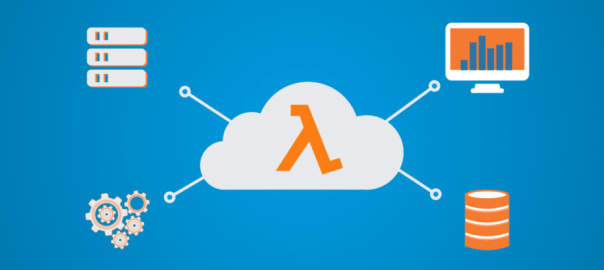
AWS Lambda is an ingredient in amazon serverless computing. Lambda allows us to run server-side code without thinking about the server. It abstracts all of the other components i.e. servers, platforms, virtual machines, etc. that are needed to run server-side code. So we can just focus on the code and not the server. That way the time to production or deployment becomes very less. We can write a lambda function, configure it and run it in minutes.

AWS-Lambda-Computing

Another great benefit of lambda is that we just pay for the compute time we consume. That means it will charge only for the time that our code is actually executed. Also, the first one million requests are free. We have to pay for request thereafter. This a very cost-effective way to run the server-side code. To get started first we need an AWS account. After creating the account we need to go to the AWS management console.

……………………………………………………………………………………………………

Create a Lambda function with Node.js

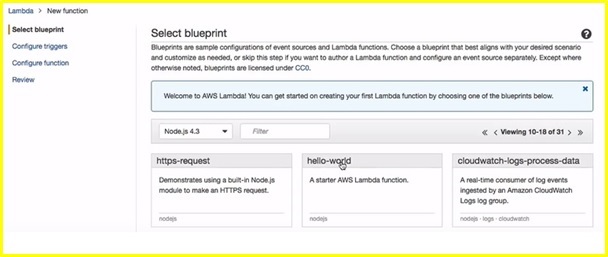
Let’s create a lambda function that picks a random number between 2 given number. First of all, login into the AWS console and then click the “Lambda”  button under the compute section. Then you can come to the “Select blueprint” section. Then, under the select runtime combo box, select the latest node.js version. Amazon gives you some basic blueprints there. We will just select the simple hello world function to start with.

Image1-Lambda

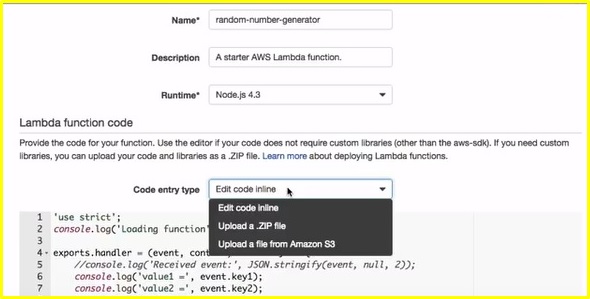
We will skip to the configure function section to create a new function. We will name our function random-number-generator. Then specify the description. Then the run time that is node 4.3. Our function is a small function so we will select to Edit code inline. The blueprint of amazon gives a very basic function.

We will change this default code to generate our random number between two given numbers.

In the beginning, just add console.log(‘Loading function’). This will help in debugging the code.’ In the default amazon function, there are some event values that are logged and in the end, it returns the first value in the callback function. Then we will add a handler function to the exports variable. And this function receives 3 variables. I.e. event, context, and callback.

 exports.handler = (event, context, callback) => {
            console.log(‘value 1 =’ , event.key1);
            console.log(‘value 2 =’ , event.key2);
            console.log(‘value 3 =’ , event.key3);
            callback(null, event.key1)
}

The callback is something we will call when our result is ready and we want to send some result back to the user. It takes 2 parameters. 1st one is the error and the second one is the success message. The variables could be string or JSON object.

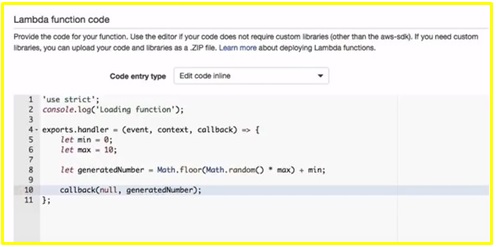
We will delete all these default codes and write our own code. So, first of all, we will define and set the minimum and maximum number.

 exports.handler = (event, context, callback) => {
           let min = 0;
           let max = 10;
}

Now we will define another variable for the random number.

exports.handler = (event, context, callback) => {
            let min = 0;
            let max = 10;
            let generatedNumber = Math.floor(Math.random() *  max) + min;
}

Mmath.random() generates a random number between 0 and 1. And it’s a floating-point number, so we multiplying it by max and the round it and add the minimum. That gives us a random number between the minimum and maximum number.

Now we are done and want to return the random number. So we will call the callback function.

callback(null, generatedNumber);

 Here there is no error handler implemented so we will just return null in place of the error parameter. And the  generatedNumber.

That’s it, the code part is done.

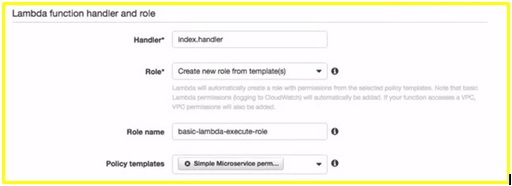
Now scroll down. And let’s define our handler. The default is index.handler. Index refers to the filename and handler is the name of the variable that is attached to the exports. We will leave this by default.

Now, we will create a new Role and give the role name as ‘basic-lambda-execute-role’. Then under the policy template, we will select ‘Simple Microservice Permissions’.

Next is the advanced settings.

Each lambda function will run in a container & that container will have some memory allocated to it. So here we can pick how much memory should be allocated to our function. Our function is a basic function. So will select 128MB. That is more than enough for our function.

This does not only defines the memory allocated to the function but also the amount of processing power amazon uses to execute our function. If we have a more resource-intensive function then we can increase the memory usage and we will get a faster performing function. Then for the timeout, we will leave it to 3 secs that is enough. If our function does not finish within this timeout then Amazon will return an error message. We will leave the VPC to no VPS and move next. In the next page, amazon lets us review our configuration for our function. And then click the create function. There we will get the msg that our function is created. And we can see the dashboard for our function.

On the dashboard we can see our code, configuration, triggers, and also we can monitor our function as well

Let’s test it by clicking the Test button there. If we scroll down we can find that the function has executed successfully and also we can see the result random number.

So that’s it. We have our random number generator lambda function is running now.

……………………………………………………………………………………………………

The views and opinions expressed in this article are those of the author. To know more about our company, please click on Mindfire Solutions. 

Overlooking Web Accessibility


The Internet is an ever-increasing storehouse of knowledge. The web and the internet as a whole serve as an important resource in many aspects of our lives: education, employment, recreation, commerce and more. Web Accessibility simply means that the web is to be made accessible to everyone. And that includes people with special abilities too – an aspect generally overlooked in haste. 

Web Accessibility

The concept of Web Accessibility has been around for a decade, but it is unfortunate that true meaning in its entirety has been lost on many of us, the web developers. It’s time that we built ramps to our sites so that it benefits not only people with disabilities but also enhances the experience of all types of users as a whole.

……………………………………………………………………………………………………


Let’s see some examples:  When you are watching a video in a noisy environment and cannot perceive the audio correctly. Without being able to hear the audio, you have to guess what the whole video is about. It can be frustrating, right?


Let’s take another one:  If you have broken your arm in an accident and can’t use the mouse to explore the web. You have to remain cut off from the internet until you recover. Or find ways to manage to access it with difficulty, mostly through pain, or be at the mercy of people who would spare some time to assist you.

There are people out there who face these challenges at every instance of their attempts to access the Web. The true essence of Web Accessibility lies in addressing such concerns and ensuring that the Web is accessible by all, without any discretion. 

The World Wide Web Consortium(W3C) published a set of guidelines, Web Content Accessibility Guidelines or WCAG 1.0 in 1999, as an initiative to the Web Accessibility Initiative(WAI) project. The revised version, WCAG 2.0 was published in 2008, which is more technology-neutral, and therefore, is widely accepted by the developers to make their site more accessible.

It may seem like a huge task to accomplish at first, but in reality, it takes only small steps to make your website accessible to all. Steps that should be undertaken are 

  • Using alternative texts, and descriptions for the images.
  • Adding subtitles and transcripts for videos.
  • Ensuring that your site is fully and equally accessible by the keyboard.
    Making use of the Accessible Rich Internet Tags (ARIA) tags.
  • Having a good color contrast.

These are some tools which can help to make your website more accessible:

So, let’s look at the bigger picture and start taking the necessary steps towards building a platform that is more accessible and more usable, and fulfill our responsibilities as web developers. It’s high time we focused on the masses who might be unable to access the internet just like normal people can. The onus lies with us to take individual responsibility of the same and spread the awareness to others. The realization that mere oversight or negligence on our part can be the source of much trouble for others should guard us against it. 

……………………………………………………………………………………………………

The views and opinions expressed in this article are those of the author. To know more about our company, please click on Mindfire Solutions. 

Wednesday, 20 December 2023

Role of AI in Chronic Care Management

Effectively managing chronic diseases such as asthma, diabetes, cancer, and several others have been one of the biggest challenges for healthcare providers worldwide. According to a study, chronic diseases are responsible for 70% of deaths and about 50% of the disease burden globally. Owing to this, we will discuss how AI in chronic care management can change these numbers.

AI in critical care

As the pandemic unleashed a global health crisis, many countries faced a shortage of healthcare professionals and medical resources. This caused several hurdles for patients with chronic conditions to get treatment at the right time. Such conditions forced chronic patients to adapt to remote and digital treatment, which is the new normal in the current world.

For medical professionals to deliver quality remote healthcare, it has become essential to leverage fast-emerging technologies like Artificial Intelligence (AI) and Machine Learning (ML).

Both AI and ML have already shown how they can significantly improve the efficiency of operations in various other industries like e-commerce, manufacturing, automotive, etc. In this article, we will take a look at the role of AI in Chronic Care Management (CCM).

Key Benefits of Chronic Care Management

Before we understand the importance of AI in Chronic Care Management, let us look at some key benefits of Chronic Care Management: 

  • Chronic Care Management or CCM offers an organized approach to dealing with chronic conditions, making the process more coordinated for patients as well as the healthcare provider.
  • Healthcare providers can build long-term relationships with patients through their CCM services, which can result in increased revenue.
  • It can prevent unnecessary visits to partitioners.
  • Researchers have proved that CCM can offer quality healthcare to patients at a lower cost.

What is the Role of AI in Critical Care Management?

Here is how AI in chronic care management can turn around the situation:

●     Medical Data Analysis

An extensive medical data set will be required to utilize AI in chronic care management at its full potential. In today’s digital world, it can be easily gathered throughout the patient life cycle via mobile applications, IoT devices, and patient portal software. An Al-based algorithm can analyze this pool of data and generate new insights and opportunities for both patients and medical professionals in CCM. This can streamline the overall chronic care management processes.

●     Prognosis and Prevention of the Disease

One aspect of CCM is to prevent diseases from happening. With the help of AI, practitioners can identify the choric disease to which the patient is susceptible. This allows the doctors to take the correct preventive measures and circumvent the chronic condition.

In a study published by Yannis Paschalidis in Harvard Business Review, healthcare professionals were able to forecast hospitalizations due to diabetes and heart disease a year in advance using machine learning and Electronic Health Records (EHRs) with an accuracy of 82%. 

●     Diagnosis of Diseases

Many recent studies have proved that AI can also be indispensable when it comes to the diagnosis of diseases. Al-algorithms can easily detect diseases based on data points like medical imagery, ECG data, patients’ demography, and their medical history. Such developments have led to time and cost-effective CCM service. It also has significantly improved remote diagnosis.

●     Treatment

The healthcare data can be used to create AI/ML models that can assist physicians in medication modeling and treatment suggestions. These models can be further applied to suggest appropriate dosage and treatment plans for the patient.

A personalized plan and treatment for individual patients can also be created by AI. The personalized treatment can enable clinicians to intervene before a patient’s condition becomes critical, making CCM more effective.

Recently, a company named IBM Watson has achieved some remarkable results by utilizing AI in the field of oncology. The organization performed genetic data analysis and was successfully able to identify the rare secondary leukemia caused by myelodysplastic syndromes.

●     Remote Patient Monitoring (RPM)

With an AI-powered CCM, healthcare professionals can constantly monitor a patient’s vitals like blood pressure, pulse rate, temperatures, etc., from the comfort of their home. The AI can also send an alert to health professionals if there is any sudden or critical change in the vitals of a patient.

●     Virtual Assistant

Chronic diseases generally last for a lifetime. As the patient gets older, it gets difficult for them to keep track of medication and appointments, which causes disturbance in their chronic care management. In such cases, an AI-powered virtual assistant can come in handy for the patient. It can assist them by ensuring drug adherence and also monitor their vital data.

For example, a Meditech company created AI-embed nurse avatars that send notifications to the patient each morning for a check-in routine, record their vitals, and sends alerts for timely intake of medicine.

Another aspect of chronic care management is measuring and managing the patient’s chronic pain. Here again, AI can assist in detecting chronic pain by monitoring the facial muscle movements of patients who are unable to self-report the pain to their physicians.

Conclusion

Artificial Intelligence can offer actionable insights to guide clinical decisions and allow physicians to diagnose, treat and handle chronic conditions remotely, thus making chronic care management more efficient, accessible, and affordable.

That’s why many healthcare organizations have begun to utilize AI in their chronic care management services. If you are also looking to leverage AI to improve your chronic care management, you will need to hire or work with people who have relevant expertise and skill set.

Mindfire Solutions is an IT-service provider that has worked with several healthcare organizations over the years to provide customized healthcare tech solutions that are highly cost-effective, secure, and scalable. Visit Mindfire Solutions to learn more about us.

Tuesday, 19 December 2023

How effective is Swift’s AR technology in developing immersive applications?

Introduction:

Since time immemorial, humans have been imaginative and have always envisioned new concepts, such as superheroes or aliens. However, the most recent obsession among innovators is immersive technology, i.e., integration of virtual content with the physical environment, with about 6.3 billion dollars in revenue generated in 2020. This is evident from the popularity of Nintendo’s Pokémon Go game and IKEA Place.

AR Application

Escalated by the post-pandemic environment, rapid digitalization and increased reliance on smart devices have led businesses to look for ways to cater to people using immersive applications. Immersive applications improve processes by bringing digital elements for better visualization, increasing user experience that translates to profitability.

Immersive applications actualize distinct experiences by integrating the physical world with a simulated reality. These technologies allow humans to have new experiences by enhancing, extending, or creating a mixed reality.

Among the different types of immersive technology are Augmented Reality (AR), 360, Extended Reality (XR), Mixed Reality (MR), and Virtual Reality (VR). The augmented and virtual reality market will surge into the market size of 160-billion-dollars by 2023, according to Statista’s forecast. Consumers’ attraction to immersive applications is visible by the increasing market size encouraging developers to offer relevant solutions.

Developers can create AR application for Apple products using various tools, frameworks, and languages including, but not limited to Xcode, ARKit, RealityKit, Swift, and AR creation tools.

This article involves understanding the efficacy of Swift in AR technology for developing immersive applications for business initiatives. Prior to that, it is crucial to comprehend AR and its effect on immersive applications.

Augmented Reality Apps and Its Applications

AR works by layering a digital layer on top of the real world and enhancing the user experience. The digital layer or augmentation consists of information or content consisting of videos, images, and 3D objects, providing a naturally semi-immersive and visual experience for user interaction.

AR has unlimited scope for innovation due to its non-restrictiveness of user vision, cost-effectiveness, and high engagement. Mobile AR users are expected to surge from 200 million in 2015 to 1.7 billion worldwide by 2024.

AR Application across industry verticals:

Apps use augmented reality to bring products to life by using 360-degree views either with headsets or through smartphone cameras.

  • Automotive Industry is using AR for designing, testing, and sale of vehicles saving much money and improving products simultaneously, e.g., Jaguar Land Rover, BMW Virtual Viewer, Hyundai AR Lens for Kona.
  • The real estate industry is being transformed by using AR technology and is bringing the advantage of viewing properties from people’s homes.
  • The tourism industry uses AR technology to provide users with amazing experiences of the various vacation locations, e.g., World Around Me, Viewranger, Smartify, AR City, Guideo, Buuuk.
  • AR provides simulation of work areas and models to help healthcare professionals familiarize themselves. This helps them to work on real patient bodies expertly.
  • Users can experience an immersive experience in retail and try things before making purchases using the plethora of AR apps for online shopping, including clothing, furniture, beauty products, and many more, e.g., Houzz, YouCam Makeup, GIPHY World, Augment.
  • AR also has wide applications in the education industry, bringing a new dimension to lessons and experiments, e.g., Mondly AR.
  • Educational, entertainment, and practical applications in real life, e.g., ARCube, AR-Watches, MeasureKit, Jigspace.
  • Many AR-powered navigation apps assist users by supplementing roadmaps with interactive features, e.g., google maps live view in iOS.
  • Gaming is one of the most popular applications of AR providing entertainment, e.g., Angry Birds AR.
  • AR has provided significant benefits in the defense sector too by offering AR-simulations of machines allowing safe and easy assimilation of information regarding the work environment and equipment.

Swift and AR Technology

Apple has introduced a comprehensive set of tools and technologies for creating amazing AR application as mentioned below:

Swift is an open-source general-purpose compiled programming language developed by Apple for its app development.

Xcode is an integrated development environment for iOS and Mac. It has all the tools needed to develop an application, including a compiler, a text editor, and a build system in one software package. Xcode uses the Swift programming language to deliver an assortment of AR templates to create AR application rapidly.

ARKit is a framework for developers that allow designing augmented reality apps for iOS devices, such as the iPad and iPhone. It helps to device AR experiences quickly using the camera, motion sensors, and processors of the iOS devices.

ARKit Features:

ARKit empowers the developers to construct AR features for apps regardless of their previous experience. It offers multiple features to benefit the users and developers alike.

  • Location Anchor: This allows the anchoring of AR creations to specific geographical locations and offers various angles for viewing.
  • Motion Capture: Intensifies AR experience using one camera to record the real-time motion.
  • Enhanced Face Tracking: Amplifies AR experience for users with a front-facing camera.
  • Scene Geometry: Prepares a topological map with labeled objects of any space.
  • People Occlusion: Enables realistic responses of AR creations in the presence of obstacles such as persons and green screen effects in all environments.
  • Depth API: Adds precision and occlusion to the AR object, increasing the user’s immersive experience.
  • Instant AR: This helps in immediate AR deployment in the real environment.
  • Simultaneous Camera Usage: Maximizes AR object performance and delivery by utilizing both the front and back camera for a new experience.

Apple’s AR Creation tools consist of a reality converter and reality composer. Reality Converter offers the display, customization, and conversion of 3D models to USDZ to integrate them effortlessly to Apple tools and AR-enabled devices. In addition, Reality Composer facilitates the construction, assessment, refinement, and simulation of AR experiences using an intuitive interface.

The creation tool offers the following advantages:

  • Powerful built-in AR library to create any virtual object or use USDZ files to continue working on a previous project.
  • Incorporates dynamism into the AR using animations and audio for adding little details like movement, vibrations, and more.
  • Record and play feature offers specific information capturing using camera and in-built sensors in predetermined locations.
  • Delivers smooth transition between all Apple platforms and devices.
  • Supports export to USDZ, including all components authored in Reality Composer.

Benefits of Swift for creating AR applications:

Xcode powered by Swift, plays a leading role in bringing AR to users with a short turnaround time. The following merits make Swift the favored choice by businesses.

1. Accelerated Development:

Swift has a low code requirement due to its simple syntax. In comparison to Objective-C, it is easier to read and write. With built-in concurrency support and reduced code size, there is faster coding, resulting in fewer problems and easy maintenance.

According to Apple Inc., a Swift application is up to 2.6 times faster than Objective-C and 8.4 times faster than Python. Swift’s LLVM, a compiler framework that enables speedier code processing, further optimizes this speed for better performance. All these qualities contribute to the faster development of AR applications.

2. Scalability:

The AR apps created with Swift are highly scalable, i.e., the apps can be updated with new features as and when needed without any worries resulting in future-proofing. The elementary readability and simple syntax combined with effortless onboarding for new developers to the team makes it a preferred choice.

3. Security:

Swift provides robust protection with its error control and typing system to avert code crashes. Hence, with a concise feedback loop, developers can promptly find and fix the code’s errors. This removes the risk of time and effort wastage due to bug fixing.

4. Interoperability with Objective-C:

With the excellent benefit of interoperability with Objective-C, Swift language provides the unique advantage of fluid cooperation for AR app extension or updates. Above all, more features are added quickly, and the risks associated with porting are prevented.

5. Memory Management:

With in-built memory management and tracking performed by Automatic Reference Counting (ARC), developers do not need to be bothered about conscious memory management. In other words, ARC also enhances the app’s performance and does not affect the CPU or memory.

Combined with Swift’s in-built dynamic libraries, it reduces the app size and memory footprint, eliminating the need to constantly oversee and retain every class count. For instance, Swift 5 introduced an Application Binary Interface that decreases the bundle size and increases version compatibility yielding a much more stable application.

6. Cross-device support:

Using Swift in both the backend and front-end of AR application development supercharges the development process by enabling extensive code sharing and reuse. This allows cross-device support across all Apple platforms, including iPhone, iPad, MacBook, Apple Watch, and Apple TV and Linux platforms.

Final Thoughts:

Swift has tremendous potential to transform businesses by revolutionizing user lifestyles through engaging and riveting AR experiences. The above benefits highlight how Swift empowers the developers to create stable, secure, and high-performance AR application.

With the demonstrated success of various AR games, creative design solutions, and e-commerce apps, Swift is the first choice for any custom AR application development for Apple products.

Like other businesses, if you too are looking for custom AR Application development Mindfire Solutions can be your partner of choice. We have a team of highly skilled and certified software professionals, who have developed many custom solutions for our global clients over the years.

Here are a few interesting projects we have done. Click here to know more:

Case study on device for medical compliance.

Case study on e-commerce site for freight.

Effectiveness of the Membership/Subscription Model in E Commerce

In recent years, the membership/ subscription model in e commerce has become increasingly popular among businesses across the board. Platforms such as Netflix, Amazon, and Spotify are some examples that have tremendously benefited from the subscription-based model. The subscription-based pricing strategy is seen as a way to attract and retain customers by providing incentives such as discounts, loyalty programs, and early access to products or services.

Subscription Model in e-Commerce

According to Gartner, by the end of 2023, 75% of organizations selling direct-to-customers will adopt a subscription-based pricing model. From these numbers, one can easily conclude that the subscription model is here to stay.

But why are businesses so keen on adopting this pricing model?

In this article, we will discuss the effectiveness of the membership/ subscription model and some of the challenges businesses can face while adapting to this model.

Benefits of a Membership/ Subscription Model in E Commerce

  • Accurate Revenue Prediction

Subscription-based businesses can accurately forecast their revenues and profits as they receive a relatively consistent level of income from the customers. This allows them to plan their operational, marketing, and development costs better.

Additionally, since the customers purchase their products at a regular cadence, the pricing model businesses can also better manage their inventory.

  • Reduce Customer Acquisition Costs

The cost of acquiring new customers is continuously increasing, with Harvard Business Review estimating that customer acquisition can be about 15 times more expensive than retaining a customer. The average customer acquisition cost, or CAC, for ecommerce businesses, is around $45 per customer.

The membership model allows businesses to build long-term relationships with already existing customers. This way, companies can focus on customer referral programs and word-of-mouth marketing, which is less expensive than paid marketing campaigns and result in a reduced CAC and increased profits.

  • Higher Customer Retention Ratio

The ecommerce subscription model offers businesses opportunities to improve their customer retention ratio. With this pricing strategy, businesses can offer exclusive incentives and rewards that encourage subscribers to stay longer with the platform and provide a more personalized service to their customers.

For example, Stitch Fix, an online fashion company that offers a subscription-based model, asks its customers a few questions about their clothing style at the time of onboarding and recommends clothing items accordingly. This way, customers receive personalized outfits tailored to their individual needs, which improves the customer experience on the platform and results in a better retention rate.

  • Increased LTV

LTV, or Lifetime Value, is an important metric for ecommerce stores that measures how much a customer spends in their entire life on the platform. Studies have shown that the platform that offers subscriptions can increase their LTV by 230%. This is due to the fact that subscription business models are more focused on providing consistent value over an extended period of time to their customers.

  • Higher Customer Engagement

For businesses with a one-time product purchase mode, it takes significant effort, strategizing, and investment to engage customers with the brand. However, if a customer has subscribed to a business, it means they found value in the products and services of the brand and are interested to hear more from them. This makes it easier for companies to engage with the subscribers and also encourages them to use the platform more frequently.

Challenges with the Subscription Model

From the above benefits, we can see that the subscription/membership model is an effective way to scale your business and generate more revenue. However, ecommerce businesses can face several technical challenges while adopting this pricing strategy on their platform.

Subscription Customer Management

Usually, subscription-based businesses have several customers visiting the platform at the same time. It can be challenging to manage customers’ orders, purchase history, billing information, and communications needs with a dated system. This can lead to inaccurate customer data and result in poor customer experience.

Flexible Subscription Options

Subscriptions are often tailored to fit the customer’s needs. Offering flexible subscription plans is a great way to attract more customers; however, it also comes with its challenges, such as added complexity in billing and inventory management system integration.

Security Threats

According to studies, the ecommerce industry is currently facing 32.4% of all successful cybersecurity threats annually, making it essential for such businesses to be well-equipped with appropriate tools to avert such threats. This is especially crucial for businesses with a subscription model, as they consist of customers making recurring payments at once. If appropriate measures are not taken to ensure the safety of each payment gateway, it can make the platform vulnerable to attacks. Subscription businesses must invest in advanced security technologies to provide secure payment gateways and protect customers’ data and privacy.

Failed Transactions Management

For businesses with a significant number of subscribers, it can be difficult to notice when transactions fail. Furthermore, manually going through customer records and identifying failed transactions can be a time-consuming task. Subscription businesses need an effective system to send alerts about such incidents and take prompt action.

Conclusion

The membership/ subscription model in e commerce has proven to be an effective pricing strategy for ecommerce stores and other businesses. It allows businesses to increase their customer loyalty and lifetime value while reducing costs associated with an acquisition. Overall, it is a great option for any business that is looking to build long-term relationships with its customers and drive more sales.

However, adapting to a subscription model also comes with its own set of challenges, which, if not addressed, can lead to poor customer experience and, eventually, loss of subscribers.

We provide e commerce software development services, assist businesses in navigating these challenges and creating a customer-centric ecommerce platform. We leverage cutting-edge technologies to address the pain points and provide a solution that is tailored to your business
Visit Mindfire Solutions to learn more about us.

Tuesday, 12 December 2023

The Role of Artificial Intelligence in Enhancing the E-learning Experience

The e-learning industry is one of the most rapidly evolving fields. According to Statista, in 2019, the global e-learning market was valued at $200 billion and is expected to cross $400 billion by 2026.

With the growing market size, it is imperative that organizations explore new technologies that can enhance the e-learning experience. One such technology, which has tremendous potential, is artificial intelligence or AI.

AI-driven applications are enabling students to learn faster and more effectively while also giving teachers access to powerful tools that can help them tailor their lessons for maximum impact. Studies show that in 2022, the market value of AI in the e-learning industry was $4 billion and is projected to reach $30 billion by 2032.

In this article, we will look into how leveraging artificial intelligence can enhance the learning experience for learners.

 Impact of AI on Elearning Experience 

  • Personalization of Learning

Everyone learns differently, and the traditional one-size-fits-all teaching approach fails to keep up with individual learning needs.

AI-driven applications can help customize the learning experience by analyzing data from the user’s learning journey to create personalized experiences. The AI algorithm can track the progress of each student through the course and identify the knowledge gap.

Based on this data, the algorithm can recommend learning paths and resources that better cater to the learners’ individual needs. This process is called adaptive learning. By providing a customized learning experience, AI can help students stay motivated, engaged, progress at their own pace, and get a better understanding of the subject.

  • Faster Content Creation

Creating e-learning courses is a time-consuming task that can take several weeks to complete. AI-powered tools can help speed up the content creation process with the help of language modeling that can analyze data from existing content, such as textbooks or legacy courses, to recommend new topics. This reduces the time-to-market, as the instructors don’t have to start from scratch.

Another benefit of leveraging AI in e-learning is that it can be used to translate content into other languages or localize your existing courses so that you can reach new audiences from around the globe.

It can also enrich the learning experience by providing innovative ways of presenting information, such as visualization, simulation, and web-based studies.

  • Virtual Assistants

It is difficult for instructors to constantly monitor each learner and provide them with timely guidance. AI-powered virtual assistants such as chatbots can help answer common questions from learners, provide real-time feedback on assignments, and answer questions related to the course material.

These virtual assistants can also connect learners with instructors if the query is complex. This means that students can receive help for common queries outside of traditional teaching hours, and teachers can focus on resolving complex doubts only. 

  • Automated Grading

A major part of any e-learning course is assessments, and grading them can be a tedious task. Manually evaluating assignments and tests is laborious, time-consuming, and prone to human errors.

AI-driven tools help automate the process by leveraging natural language processing (NLP) to assess long answers in written form. This speeds up the assessment process as instructors do not have to manually grade each answer. Even if there are subjective questions, AI algorithms can judge based on keywords and patterns that they identify from the answer provided.

Automated tools can also grade students’ assignments in real-time and provide instant actionable insights about their performance. This helps learners gain a better understanding of their strengths and weaknesses, which gives them an opportunity to improve quickly.

Furthermore, these tools can also check answers for plagiarism and detect similarities between learners’ submitted assignments.

  • Gamification

Gamification involves the integration of game mechanics into the learning process. It can make learning more engaging, fun, and interactive, which can improve knowledge retention. AI can enhance gamification by analyzing student performance and adapting the game’s difficulty to match the student’s ability. AI can also provide personalized feedback and rewards to motivate students and enhance the learning experience.

  • Content Analytics

Instructors need to track the performance of students and identify areas of improvement. AI-driven analytics tools can help instructors analyze data such as engagement with content, time spent in completing tasks, or the number of attempts made for an assignment. This allows instructors to determine which topics are challenging for learners and fine-tune their strategies accordingly.

AI also helps instructors measure the effectiveness of their teaching strategy by understanding learner behaviors and preferences. Such data points can help improve the learning outputs and student satisfaction levels.

  • Easy Access for Students With Special Needs

AI-driven technologies allow instructors to customize the learning experience based on students’ disabilities and special needs. This helps make e-learning accessible to all, regardless of their physical or mental abilities. AI tools can also recognize and respond to non-verbal communication signals such as facial expressions, behavior, eye movements, gestures, etc., that enables convenient access and a better learning experience for learners with communication impairments.

Conclusion

AI has immense potential to transform the e-learning industry. With the help of AI-driven tools, e-learning can be personalized and automated to offer a superior learning experience. It can also enhance accessibility to education by providing learners with disabilities a way to access online resources. With the right strategies and implementations, AI can help make learning more effective and efficient.

If you are looking to integrate AI into your e-learning processes, Mindfire Solutions is here to assist you.

Mindfire Solutions is a leader in providing AI-driven solutions for the ELearning industry. With our expertise in machine learning and natural language processing, we can help transform e-learning systems into smarter, more efficient learning platforms.

Visit Mindfire Solutions to learn more about our strengths and capabilities.

WebTransport: Bridging the Gap Beyond WebRTC & WebSockets

Imagine a world where real-time communication is faster, more secure, and more efficient than ever before. A world where online gaming feels as responsive as playing in person, video streaming is seamless and buffer-free, and IoT devices transfer data with lightning speed. Welcome to the era of WebTransport, the cutting-edge technology poised to transform the way we connect and communicate over the web. It’s time to say goodbye to the limitations of traditional protocols and get ready to be amazed by the endless possibilities of WebTransport.

webtransport-featured-img

In this blog article, we will explore the advantages of WebTransport over the widely adopted WebSockets and WebRTC technologies. We will uncover how WebTransport harnesses the power of datagrams, streams, and the cutting-edge QUIC protocol to redefine real-time communication, offering unparalleled benefits for a wide range of applications.

We will also discuss the current state of WebTransport adoption and the future of this promising technology.

So, without further ado, let’s dive into the world of WebTransport!

WebTransport is a web API that uses the HTTP/3 protocol as a bidirectional transport. It’s intended for two-way communications between a web client and an HTTP/3 server. It supports sending data both unreliably via its datagram APIs, and reliably via its streams APIs.

How WebTransport works under the hood

WebTransport can be used to send and receive data in two different ways: datagrams and streams.

  • Datagrams are individual packets of data that are limited in size by the maximum transmission unit (MTU) of the underlying connection. They may or may not be transmitted successfully, and if they are transferred, they may arrive in an arbitrary order. Datagrams are provided through the QUIC datagram extension and are prefixed with a session ID that the recipient can use to multiplex different transports
  • WebTransport also uses streams to send and receive data that need reliable and ordered delivery. Streams are provided by creating an individual unidirectional or bidirectional QUIC stream and are also prefixed with a session ID. Streams provide better transport efficiency than the older packet mechanism.

Process:

  1. The client and server first establish a QUIC connection. This is done by using the QUIC handshake protocol.
  2. Once the connection is established, the client and server can begin sending data to each other.
  3. Data is sent in packets. Each packet is encrypted and includes a sequence number.
  4. The receiver uses the sequence number to reorder the packets and decrypt them.
  5. If a packet is lost, the receiver will request a retransmission.
  6. The sender will retransmit the lost packet.
  7. This process continues until all of the data has been sent and received.


WebTransport offers versatile capabilities for sending multiple types of data over the same connection. It allows for the reliable transmission of text or file data while concurrently enabling the unreliable transmission of video information. This flexibility enhances the efficiency and richness of communication among numerous simultaneous users. WebTransport facilitates the segregation of different content types on separate channels, preventing one type from blocking the transmission of others. Additionally, the ability to establish bidirectional streams enables quick data exchange between the server and client, making it ideal for implementing messaging systems and facilitating rapid communication.

What is QUIC Protocol?

QUIC, short for “Quick UDP Internet Connections,” is a modern transport protocol designed to enhance internet communication. Developed by Google, QUIC aims to replace TCP by utilizing UDP for faster and more efficient data transfer. It incorporates features like multiplexing to enable simultaneous transmission of multiple data streams, built-in encryption for enhanced security, and advanced congestion control algorithms to optimize network performance. With its standardization efforts by the IETF and increasing adoption by major internet players, QUIC holds the potential to revolutionize internet communication, offering improved speed, security, and reliability for a better web browsing experience.

QUIC is still under development.

Here are some of the benefits of using QUIC:

Performance: QUIC can improve the performance of web applications by reducing latency and increasing throughput. This is because QUIC is a connectionless protocol, which means that it does not need to establish a connection before sending data. This can reduce the amount of time it takes to send data, which can improve the performance of web applications.

Security: QUIC can improve the security of web applications by providing encryption and authentication. This is because QUIC uses TLS 1.3 to encrypt all data that is sent over the connection. This ensures that the data is secure from eavesdropping and tampering.

Efficiency: QUIC is more efficient than TCP in terms of bandwidth and CPU usage. This is because QUIC does not need to resend data that is lost, which can save bandwidth. QUIC also uses less CPU than TCP, which can save power.

Advantages of WebTransport over WebRTC/Websockets

WebTransport offers several advantages over WebSockets and WebRTC in certain use cases. Here are some key advantages of using WebTransport:

Enhanced Performance: WebTransport introduces the QUIC protocol, which offers significant performance improvements over WebSocket and WebRTC. It leverages UDP-based transport, reducing latency and providing faster data transmission. This means quicker response times, smoother real-time interactions, and improved user experiences.

Efficient Resource Utilization: Unlike WebSocket and WebRTC, WebTransport utilizes a more efficient resource management approach. It requires fewer server resources to establish and maintain connections, allowing servers to handle a larger number of simultaneous connections without compromising performance or scalability.

Bidirectional: WebTransport is a bidirectional protocol, which means that data can flow in both directions between the client and server. This is useful for applications that need to send and receive data simultaneously, such as chat applications and multiplayer games.

Streamlined Data Transfer: With WebTransport’s data grams and streams, data can be sent and received in a more organized and efficient manner. It allows for the creation of bidirectional streams, enabling simultaneous data transfer between the client and server. This enables the development of advanced features such as reliable file transfer, simultaneous video streaming, and real-time collaboration.

More Reliable: WebTransport is a reliable protocol, which means that data is guaranteed to be delivered in the correct order. This is important for applications that require high reliability, such as gaming and video streaming.

Robust Security Measures: WebTransport’s streams API, based on the secure QUIC protocol, offers robust security for encrypted streaming. With built-in encryption, it ensures data confidentiality. Additional measures such as Origin header usage and specific opt-in requirements enhance security. WebTransport provides a secure environment for streaming, protecting the integrity and privacy of transmitted data.

Seamless Integration: WebTransport is designed to seamlessly integrate with existing web technologies. It can be easily adopted and incorporated into web applications without requiring major architectural changes. This makes it a viable option for migrating from WebSocket or WebRTC while preserving the functionality and user experience of the existing application.

Support for server push: WebTransport enables servers to proactively push data to clients, eliminating the need for clients to continually poll for updates.

Specific Problems Addressed by WebTransport

Higher latency in WebSockets: WebSockets introduce additional latency due to the handshake and framing overhead, which WebTransport minimizes.

Lack of stream multiplexing in WebRTC: WebRTC does not natively support stream multiplexing, making it less efficient for scenarios requiring multiple concurrent data streams.

Limited transport options in WebSockets: WebSockets primarily provide reliable, ordered transport, whereas WebTransport offers flexibility by supporting both reliable and unreliable transport modes.

Inefficiency of polling for updates: With WebTransport’s server push capability, the need for clients to continually poll the server for updates is eliminated, reducing network congestion and improving efficiency.

Difficulty in extending protocols in WebSockets and WebRTC: WebTransport addresses this problem by providing a more extensible framework, allowing the introduction of new protocols and features without disrupting existing implementations.

Connect to a server using WebTransport QUIC using JavaScript

  1. Client creates a new WebTransport object.
  2. Client calls the connect() method on the WebTransport object, passing in the URL of the server.
  3. WebTransport object establishes a QUIC connection to the server.
  4. Client and server negotiate the parameters of the QUIC connection, such as the encryption and congestion control algorithms.
  5. The client and server can now send data to each other over the QUIC connection.

Here is an example using javaScript:

const webTransport = new WebTransport();

webTransport.connect(‘https://example.com’);

webTransport.on(‘message’, (data) => {

  // Handle the data received from the server.

});

webTransport.on(‘error’, (error) => {

  // Handle the error that occurred while connecting to the server.

});

Possible use cases 

𝐆𝐚𝐦𝐢𝐧𝐠: WebTransport’s bidirectional streams are super helpful for making games. They make sure that the data sent by the server arrives quickly with very little delay. This is awesome for action-packed games like shooting, driving, or fighting because it reduces the time between when you do something on your device and when you see the game respond. It’s also great for cloud gaming services, where the game is run on a powerful server and streamed to your device. With WebTransport, the back-and-forth communication between you and the game server happens fast, making the whole gaming experience smoother and more responsive.

For example, it could be used to send real-time game state updates and player input to other players.

𝐕𝐢𝐝𝐞𝐨 𝐬𝐭𝐫𝐞𝐚𝐦𝐢𝐧𝐠: WebTransport is a good choice for video streaming, as it can provide a secure, reliable, and efficient way to send and receive video data. In addition, WebTransport can be used to multiplex multiple streams of data over a single connection, which can be useful for streaming video alongside other data, such as audio data or chat messages.

For example, it could be used to send video and audio data to the client without buffering.

𝐂𝐡𝐚𝐭 𝐚𝐩𝐩𝐥𝐢𝐜𝐚𝐭𝐢𝐨𝐧𝐬: WebTransport is a great fit for chat apps because it allows for fast and efficient communication between users. When we chat with someone, we want our messages to reach them quickly, and we want their responses to come back to us right away. WebTransport makes this happen by providing a smooth and low-latency connection. It ensures that our messages are sent and received almost instantly, creating a more seamless chatting experience. Additionally, WebTransport is designed to handle a large number of users at once, so even in busy chat rooms with lots of people, communication remains smooth and responsive. In simple terms, WebTransport helps chat apps work really well by making messages travel fast and keeping the conversation flowing smoothly.

IoT( Internet of Things) applications: WebTransport can be really useful for transferring data from Internet of Things (IoT) devices to servers. These devices often collect and send small bits of data regularly. With WebTransport, this data can be sent quickly with very little delay. This is important because IoT devices usually run on batteries, so it’s better if they use less energy. Plus, if there are a lot of devices connected to the internet, it can sometimes make the network slow. But with WebTransport, the devices use fewer resources and create less congestion, which means everything works better. So, WebTransport helps make IoT devices work well and saves energy at the same time.

Browser Support:

Chrome: 97+

Firefox: 114+

Edge: 97+

Safari: 16+ (partial support)

Samsung Internet: 19+

Opera: 97+

Current State of WebTransport Adoption and Future of This Promising Technology

The current state of WebTransport adoption shows promising signs for the future of this technology. Although still in its early stages, WebTransport has received significant interest and attention from developers and industry experts. The potential benefits it offers, such as improved performance, lower latency, and increased reliability, make it an attractive choice for building modern web applications. Major browser vendors have started implementing WebTransport protocols and APIs, signaling their belief in its value. As more developers become familiar with WebTransport and explore its capabilities, we can expect to see wider adoption and integration of this technology into various web applications and services. With ongoing advancements and the active involvement of the web development community, the future of WebTransport looks promising, and we can anticipate exciting developments and innovations in this space in the years to come.

Building upon Lakin’s original article, our latest piece delves deeper into the subject, providing fresh insights and a broader perspective. Unlock the true potential of real-time communication with Mindfire. Our experts specialize in enhancing applications through cutting-edge technologies like WebTransport, including QUIC and HTTP/3. Elevate user experiences and stay ahead in the dynamic digital landscape. Let us transform your apps into seamless and efficient communication hubs. Reach out for a consultation today!

Monday, 11 December 2023

Cognitive Test Automation: Harnessing Cognitive Computing for Complex Scenarios

In today’s fast-paced digital world, software testing has become an essential part of the software development life cycle. With the increasing complexity of software applications, traditional testing methods are no longer sufficient to ensure the quality of software products. This is where cognitive test automation comes into play. In this blog, we will explore the integration of cognitive computing capabilities, such as natural language processing (NLP) and image recognition, into test automation frameworks to handle complex testing scenarios.

cognitive test automation featured img

What is Cognitive Test Automation?

Cognitive test automation is a subset of test automation that leverages cognitive computing capabilities to handle complex testing scenarios. Cognitive computing is a type of artificial intelligence that mimics human thought processes. It involves the use of natural language processing (NLP), machine learning, and other advanced technologies to enable computers to understand and interpret human language and behavior.

Cognitive test automation uses these cognitive computing capabilities to automate testing scenarios that were previously difficult or impossible to automate using traditional testing methods. For example, cognitive test automation can be used to automate testing scenarios that involve natural language processing, image recognition, and other complex tasks.

Benefits of Cognitive Test Automation

Cognitive test automation offers several benefits over traditional testing methods. Some of the key benefits include:

  1. Improved Test Coverage: Cognitive test automation can handle complex testing scenarios that were previously difficult or impossible to automate using traditional testing methods. This improves test coverage and ensures that all aspects of the software application are thoroughly tested.
  2. Increased Efficiency: Cognitive test automation can automate repetitive and time-consuming testing tasks, freeing up testers to focus on more complex testing scenarios. This increases efficiency and reduces the time and cost of software testing.
  3. Improved Accuracy: Cognitive test automation uses advanced technologies such as NLP and image recognition to ensure accurate and reliable testing results. This reduces the risk of human error and ensures that testing results are consistent and reliable.
  4. Faster Time-to-Market: Cognitive test automation can speed up the software development life cycle by automating testing tasks and reducing the time and cost of software testing. This enables organizations to bring software products to market faster and stay ahead of the competition.


Challenges of Cognitive Test Automation

While cognitive test automation offers several benefits, it also presents several challenges. Some of the key challenges include:

  1. Complexity: Cognitive test automation involves the integration of advanced technologies such as NLP and image recognition into test automation frameworks. This can be complex and requires specialized skills and expertise.
  2. Cost: Cognitive test automation requires specialized tools and technologies, which can be expensive to acquire and maintain. This can be a barrier to adoption for some organizations.
  3. Integration: Cognitive test automation must be integrated with existing test automation frameworks and processes. This can be challenging and requires careful planning and execution.
  4. Data Quality: Cognitive test automation relies on high-quality data to ensure accurate and reliable testing results. This can be a challenge if the data is incomplete, inaccurate, or inconsistent.


Methodologies for Cognitive Test Automation

There are several methodologies for implementing cognitive test automation. Some of the key methodologies include:

  1. Scriptless Test Automation: Scriptless test automation involves the use of visual models and drag-and-drop interfaces to create test cases. This approach simplifies the test automation process and reduces the need for specialized skills and expertise.
  2. Model-Based Testing: Model-based testing involves the creation of models that represent the behavior of the software application. These models are then used to generate test cases automatically. This approach reduces the time and cost of test case creation and ensures comprehensive test coverage.
  3. Behavior-Driven Development (BDD): BDD involves the creation of test cases that are based on the behavior of the software application. This approach ensures that testing is aligned with the business requirements and improves the accuracy and relevance of testing results.
  4. Artificial Intelligence (AI) and Machine Learning (ML): AI and ML can be used to automate testing tasks that involve natural language processing, image recognition, and other complex tasks. These technologies can also be used to analyze testing results and identify patterns and trends.


Natural Language Processing (NLP) in Test Automation

Natural Language Processing (NLP) is a subfield of artificial intelligence that focuses on the interaction between computers and humans using natural language. NLP can be used in test automation to automate testing tasks that involve natural language processing, such as testing chatbots and voice assistants.

NLP-based test automation involves the use of NLP algorithms to analyze and understand natural language inputs and outputs. This enables testers to create test cases that are based on natural language inputs and outputs, rather than code-based inputs and outputs.


Benefits of NLP-based Test Automation

NLP-based test automation offers several benefits over traditional testing methods. Some of the key benefits include:

  1. Improved Test Coverage: NLP-based test automation can handle complex testing scenarios that were previously difficult or impossible to automate using traditional testing methods. This improves test coverage and ensures that all aspects of the software application are thoroughly tested.
  2. Increased Efficiency: NLP-based test automation can automate repetitive and time-consuming testing tasks, freeing up testers to focus on more complex testing scenarios. This increases efficiency and reduces the time and cost of software testing.
  3. Improved Accuracy: NLP-based test automation uses advanced technologies such as NLP algorithms to ensure accurate and reliable testing results. This reduces the risk of human error and ensures that testing results are consistent and reliable.
  4. Faster Time-to-Market: NLP-based test automation can speed up the software development life cycle by automating testing tasks and reducing the time and cost of software testing. This enables organizations to bring software products to market faster and stay ahead of the competition.


Challenges of NLP-based Test Automation

While NLP-based test automation offers several benefits, it also presents several challenges. Some of the key challenges include:

  1. Complexity: NLP-based test automation involves the integration of NLP algorithms into test automation frameworks. This can be complex and requires specialized skills and expertise.
  2. Data Quality: NLP-based test automation relies on high-quality data to ensure accurate and reliable testing results. This can be a challenge if the data is incomplete, inaccurate, or inconsistent.
  3. Integration: NLP-based test automation must be integrated with existing test automation frameworks and processes. This can be challenging and requires careful planning and execution.


Image Recognition in Test Automation

Image recognition is a technology that enables computers to interpret and understand visual information, such as images and videos. Image recognition can be used in test automation to automate testing tasks that involve image recognition, such as testing user interfaces and web applications.

Image recognition-based test automation involves the use of image recognition algorithms to analyze and understand visual information. This enables testers to create test cases that are based on visual inputs and outputs, rather than code-based inputs and outputs.


Benefits of Image Recognition-based Test Automation

Image recognition-based test automation offers several benefits over traditional testing methods. Some of the key benefits include:

  1. Improved Test Coverage: Image recognition-based test automation can handle complex testing scenarios that were previously difficult or impossible to automate using traditional testing methods. This improves test coverage and ensures that all aspects of the software application are thoroughly tested.
  2. Increased Efficiency: Image recognition-based test automation can automate repetitive and time-consuming testing tasks, freeing up testers to focus on more complex testing scenarios. This increases efficiency and reduces the time and cost of software testing.
  3. Improved Accuracy: Image recognition-based test automation uses advanced technologies such as image recognition algorithms to ensure accurate and reliable testing results. This reduces the risk of human error and ensures that testing results are consistent and reliable.
  4. Faster Time-to-Market: Image recognition-based test automation can speed up the software development life cycle by automating testing tasks and reducing the time and cost of software testing. This enables organizations to bring software products to market faster and stay ahead of the competition.


Challenges of Image Recognition-based Test Automation

While image recognition-based test automation offers several benefits, it also presents several challenges. Some of the key challenges include:

  1. Complexity: Image recognition-based test automation involves the integration of image recognition algorithms into test automation frameworks. This can be complex and requires specialized skills and expertise.
  2. Data Quality: Image recognition-based test automation relies on high-quality visual data to ensure accurate and reliable testing results. This can be a challenge if the data is incomplete, inaccurate, or inconsistent.
  3. Integration: Image recognition-based test automation must be integrated with existing test automation frameworks and processes. This can be challenging and requires careful planning and execution.


Conclusion

Cognitive test automation, NLP-based test automation, and image recognition-based test automation are powerful tools for handling complex testing scenarios in today’s fast-paced digital world. By leveraging cognitive computing capabilities such as NLP and image recognition, organizations can improve test coverage, increase efficiency, improve accuracy, and reduce the time and cost of software testing. While these approaches present several challenges, there are several methodologies and technologies available to help organizations overcome these challenges and reap the benefits of cognitive test automation.

Beginner’s guide to learn golang: Your first steps to get started

Google created Go programming language, also known as Golang, to address some of the shortcomings and inefficiencies they were experiencing with existing languages and tools.

Why Google created Golang

Compile time: Google has historically struggled with long compile times for its projects having large codebases. This problem has been so significant that Google has developed build tools to separate the dependency analysis and compiling, just to gain a few percent in build time using conventional languages. In an effort to address this issue, Google created the programming language Go, which is designed for faster compilation without the need for dependency checking.

String processing: Google frequently processes and analyzes large amounts of text data in the form of web pages, requiring efficient manipulation of strings. To meet this need, the company incorporated a comprehensive set of string functions into the Go programming language, which also uses garbage collection to make working with strings more efficient compared to some other languages like C++.

Concurrency: The rise of multicore CPUs in the past argued that a language should provide first-class support for some sort of concurrency or parallelism. And to make resource management tractable in a large concurrent program, garbage collection, or at least some sort of safe automatic memory management was required. To address the complexity and difficulty of concurrent programming, where multiple parts of a program run simultaneously, is challenging to do well. Go was designed to make it easier to write concurrent programs by providing built-in support for concurrency and synchronization.

Learning curve: Go is a relatively simple language with a straightforward syntax and a small set of core features. This makes it easy for programmers to learn and use, even if they are new to programming.

Modern software development practices: Go was designed to support modern software development practices such as agile development, continuous integration, and test-driven development. It includes features such as built-in testing and support for dependency management.

Go = C + strings + garbage collection + concurrency.

Key features of Go

Some of the key features of Go include:

Concurrency: Go is built with concurrency in mind and provides a number of features to make it easy to write concurrent code.

Garbage collection: Go includes a garbage collector that automatically manages memory, making it easier for developers to write code without having to worry about memory management.

Static typing: Go is a statically-typed language, which means that variables are explicitly declared with a specific type and the type of a variable cannot be changed during its lifetime. This can help catch errors at compile time and improve the overall reliability of the code.

Lightweight: Goroutines take only 8 kilobytes and you can have thousands of them.

Fast compilation: Go has a fast compiler that can quickly build large programs, making it suitable for building scalable applications.

Zero dependency: Since the language does not rely on any external libraries or frameworks, you do not need to worry about installing those dependencies on the target machine. This can simplify the deployment process and reduce the risk of issues caused by missing or incompatible dependencies. This can be particularly useful for building applications that need to be deployed in a variety of different environments.

Built-in support for testing: Go includes built-in support for writing and running tests, making it easy to test and verify code.

Strong community: Go has a strong and active community of developers who contribute to the language and its ecosystem, including libraries and tools.

Overall, Go is a versatile and powerful programming language that can be used in a wide range of projects. Whether you’re building a web application, a network server, or a command-line tool, Go is a good language to consider.

As more and more companies and people began to realize Go’s potential, it became a mainstream language to build following kinds of products.

  1. World-class system tools like Docker and Kubernetes
  2. Advanced databases like CockroachDB and InfluxDB
  3. Decentralized Blockchain platforms like Ethereum
  4. To separate configuration into infrastructure layer like Istio
  5. Faster continuous deployment like Drone.
  6. More performant messaging systems like NATS.
  7. Widely used CLI tools like Cobra

Some good resources to learn golang

  1. 𝐓𝐡𝐞 𝐨𝐟𝐟𝐢𝐜𝐢𝐚𝐥 𝐆𝐨𝐥𝐚𝐧𝐠 𝐰𝐞𝐛𝐬𝐢𝐭𝐞 provides comprehensive documentation, tutorials, and other resources for learning the language.
  2. “𝐆𝐨 𝐛𝐲 𝐄𝐱𝐚𝐦𝐩𝐥𝐞” website provides a collection of short, easy-to-understand examples of how to use various Golang features.
  3. “𝐀 𝐓𝐨𝐮𝐫 𝐨𝐟 𝐆𝐨” website provides an interactive, in-browser tutorial that teaches the basics of Golang.
  4. “Effective Go” is a free resource to learn the Go programming language and it is available on the official website of Golang. This course provides an explanation of all the key concepts in the Go programming language, how to use them, and their syntax.
  5. “GopherCon UK 2022 Conference” YouTube playlist includes a series of talks and presentations on various topics related to Golang.
  6. 𝐆𝐨𝐩𝐡𝐞𝐫𝐜𝐢𝐬𝐞𝐬 — a FREE course by John Calhoun of calhoun.io.
  7. Golang Crash Course by Traversy Media — This Go language crash course explains all the fundamentals of Golang.
  8. Learn Go Programming by Building 11 Projects — Course by FreeCodeCamp — This Golang course is completely free and published on freeCodeCamp’s YouTube channel.
  9. “𝐓𝐡𝐞 𝐆𝐨 𝐏𝐫𝐨𝐠𝐫𝐚𝐦𝐦𝐢𝐧𝐠 𝐋𝐚𝐧𝐠𝐮𝐚𝐠𝐞” book by Alan A. A. Donovan and Brian W. Kernighan is a comprehensive guide to the language, with detailed explanations and examples.
  10. “𝐆𝐨𝐥𝐚𝐧𝐠 𝐍𝐞𝐰𝐬” website provides the latest news, articles, and resources related to Golang.
  11. “𝐆𝐨 𝐅𝐨𝐫𝐮𝐦” is an online community where you can ask questions and get help from other Golang developers.
  12. “𝐆𝐨𝐥𝐚𝐧𝐠 𝐒𝐥𝐚𝐜𝐤” is an online community where you can join channels and discuss Golang with other developers.

Although the design of most languages concentrates on innovations in syntax, semantics, or typing, Go is focused on the software development process itself. Go is efficient, easy to learn, and freely available, but we believe that what made it successful was the approach it took toward writing programs, particularly with multiple programmers working on a shared codebase.

If you’re ready to turn your software development vision into reality, look no further than Mindfire Solutions. As a trusted industry leader, we are dedicated to delivering excellence in software development, innovation, and reliability. Let’s bring your ideas to life. Contact us today to start your next project with confidence.  Explore Lakin’s original article and discover a treasure trove of trending tech articles on Medium.

Wednesday, 6 December 2023

The Future of Cloud-Based Software in the Publishing Industry

Introduction

The publishing industry has undergone significant transformations over the years, with the advent of digital technologies revolutionizing the way content is created, distributed, and consumed. One of the most transformative innovations in recent times is cloud-based software. Cloud computing has gained immense popularity across various sectors, and its impact on the publishing industry is no exception. The move towards cloud-based solutions in the publishing industry is the consequence of a desire—or perhaps even a requirement—to automate work processes, reduce costs, and lessen the strain on an organization’s need for technological know-how.

Cloud-based Software in the Publishing Industry

The Rise of Cloud-based Software in Publishing

Cloud-based computing is one of the more recent technological advancements and has become an accepted standard practice in many businesses. Without even realizing it, a lot of the common tasks that businesses use on platforms like Salesforce.com, operate on cloud-based standards, as data storage and management are handled by off-site server farms rather than by the company’s own local servers or hard drives. There are countless use cases for publishers who are considering migrating portions of their business practices to the cloud. This rise in traction and popularity of Cloud technology in the publishing industry can be attributed to its numerous advantages.

Accessibility and Collaboration: Cloud-based software allows publishers to access their tools and applications from anywhere with an internet connection, enabling remote work and collaboration. Teams can collaborate in real-time, share and edit documents, and streamline workflows, regardless of their physical location.

Scalability and Cost Efficiency: Cloud-based solutions offer scalability, allowing publishers to expand or downsize their resources based on their requirements. Additionally, the pay-as-you-go model eliminates the need for large upfront investments, reducing costs and making it more affordable for publishers, especially small and medium-sized enterprises (SMEs).

Enhanced Security and Backup: Cloud service providers invest heavily in security measures, ensuring data protection and disaster recovery. Publishers can benefit from robust security protocols, encrypted data storage, and automatic backups, minimizing the risk of data loss or breaches.

Streamlined Publishing Processes: Cloud-based software streamlines various publishing processes, such as content creation, editing, layout design, and distribution. Publishers can leverage powerful tools to automate repetitive tasks, enhance productivity, and improve overall efficiency.

The Future Outlook

Content Creation and Collaboration: Cloud-based software will continue to advance content creation and collaboration in the publishing industry. Tools like Google Docs and Microsoft Office 365 have already gained popularity, allowing multiple users to collaborate in real-time. Future innovations will likely offer more sophisticated features, such as AI-powered content generation and intelligent editing tools, revolutionizing the way publishers create and refine their content.

Digital Asset Management: As the amount of digital content continues to grow, efficient digital asset management (DAM) becomes crucial. Cloud-based DAM systems enable publishers to organize, store, and retrieve digital assets seamlessly. AI and machine learning algorithms can enhance metadata tagging, search capabilities, and content recommendation, further streamlining the content management process.

Data-driven Publishing: Cloud-based software provides publishers with valuable data insights, helping them understand audience preferences, analyze market trends, and make data-driven decisions. Advanced analytics tools integrated into cloud-based publishing platforms can offer comprehensive metrics on content performance, reader engagement, and revenue generation, empowering publishers to optimize their strategies and drive better outcomes.

Personalized Reader Experiences: Cloud-based software enables publishers to deliver personalized reader experiences, tailoring content recommendations based on user preferences and behaviors. By leveraging data analytics and machine learning algorithms, publishers can create customized content, targeted marketing campaigns, and interactive digital experiences, fostering deeper reader engagement and loyalty.

Companies can even move processes related to Contracts and rights management, Supplier qualification management and paper procurement to cloud, to streamline its operation management.

Challenges and Considerations

Utilizing cloud-based services has been can benefit publishers in a variety of ways, including content management, lead generation and other business services. Since there is no one solution that works for everyone, publishers need to be well-informed about the benefits and drawbacks of any shift around cloud computing. On that note, certain challenges and considerations in particular need to be addressed:

Data Security and Privacy: As publishers entrust their content and sensitive data to third-party cloud service providers, ensuring robust security measures and compliance with data protection regulations becomes crucial. Publishers must carefully select reputable and trustworthy providers with strong security protocols.

Integration and Interoperability: Publishers often rely on a variety of software applications for different aspects of their workflow. Ensuring seamless integration and interoperability between cloud-based tools and existing systems is essential to avoid disruptions and maximize efficiency.

Connectivity and Reliability: Dependence on internet connectivity for accessing cloud-based software can pose challenges in areas with limited or unreliable internet infrastructure. Publishers must consider backup solutions and contingency plans to minimize disruptions during connectivity issues.

Conclusion

Cloud-based software has already made a significant impact on the publishing industry, revolutionizing content creation, collaboration, and distribution. For a particular organization, how much it can benefit from Cloud-based software will depend on the nature of its business model and the level of adoption of new technology. However, it will be a key factor in publishing of content at a pace that keeps up with our consumption of it. Therefore, the future of cloud-based software in publishing is promising, with advancements in content creation, digital asset management, data-driven publishing, and personalized reader experiences. While challenges like data security, integration, and connectivity persist, the benefits of cloud-based software far outweigh the drawbacks. Publishers who embrace this technology will be better equipped to thrive in the ever-evolving digital publishing landscape.